Posts Tagged: accessible toilets


23
Aug 11

Oui, oui…

This article was published in a different form in Wednesday’s Heckler column in The Sydney Morning Herald. You can link to it here.

I have some sympathy for Gerard Depardieu. You know, sometimes when you’ve gotta go, you’ve really gotta go. Doubly so when your use of a wheelchair severely limits the number of public toilet options available to you.

Last Friday I was in the QVB and an excess of caffeine did what it does. For some inexplicable reason, the disabled toilets in the QVB are on the 1st floor and the lower ground floor, accessible only by a very slow and often crowded lift. After taking the lift to the 1st floor, I found the accessible toilet locked. And it wasn’t locked by an MLAK — the Master Locksmiths Access Key system that provides people with disabilities 24/7 access via a common key. It was locked by security. I couldn’t find security so I asked a cleaner who promised to find security. After 15 minutes waiting I gave up.

Next stop was the HSBC Building, across George Street. But there was a large sign on the door of the accessible toilet ‘Door locked — see security’. Again, no sign of an MLAK lock, and no sign of security. After a search of the floor revealed no security office, I decided that as I was now very close to Town Hall station, that was a better option.

As soon as I entered the station, there was a sign that looked promising. It lead me around several corners and finally to the base of a large set of stairs — the sign pointing straight up the stairs to the HSBC Building I had just visited.

At that moment, in Friday afternoon peak hour at Town Hall Station, with no accessible toilet anywhere to be seen, the aisle of an Air France plane seemed a pretty private place for a pee.

Finally my search of the station revealed another toilet but my heart missed a beat as I saw another sign on the door. ‘Toilets only accessible with MLAK key.’ Bless CityRail. They can do no wrong by me. Trains can run late, platforms can be crowded, the Waratah trains can never be delivered — but I’ll be the last man standing (ok, sitting) and defending them.

The MLAK system is simplicity itself. It ensures those who need access get it and those who don’t are excluded.

What is it about building managers that causes them to ignore a widely accepted method of access control in favour of a solution that suits no-one? When will they get that accessible isn’t accessible if you can’t get in the door?

All I know is that unless they get it soon, they may find themselves mopping up, in the words of Gerard Depardieu, a lot more oui oui.


19
Jul 11

Guylian Belgian Chocolate Cafe, Circular Quay

20120327-212146.jpg

If you enjoy chocolate and good coffee, this is a must-visit. It is located at Shop 10, Opera Quays, so the view, as you’d expect, is wonderful. You can sit indoors or outside. With a group, I’ve always preferred outside, but there’s good circulation space inside too and a number of smaller tables if you’re sitting alone. The entry, like most shops in the Opera Quays, is flat.

While the primary food served is sweet, especially chocolate, you can also have a light meal including salads, ciabatta and savory pastries. They serve an incredible Dark Chocolate Milkshake ($9) which is truly to die for. The coffee is good too, mild, but very drinkable, and the cappuccino is served at the right temperature. And the sprinkle of Guylian Chocolate on top certainly helps.

The accessible bathroom is excellent, with good circulation space and sufficient room under the sink to really get under. Everything is easy to reach, the door locks simply and there’s even pleasant music piped in. Circular Quay and the Opera House precinct is really lacking accessible bathroom facilities. For the price of a coffee or great milkshake, this cafe offers an excellent addition.

It’s highly recommended.


9
Apr 11

Why can’t able-bodied people lock doors?

image

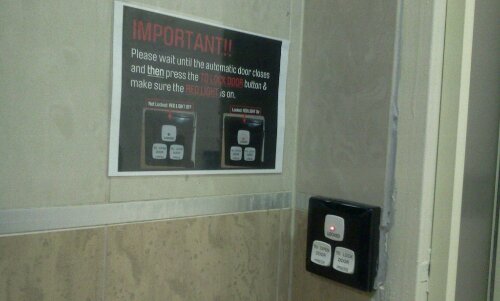
Twice in the last week I’ve pressed the ‘open door’ button on disabled toilets to reveal a seemingly able-bodied person sitting on the loo — in one case reading a newspaper. It’s bad enough to use the disabled toilet when you don’t need it. But the least you can do is lock the door!

I think I know what has happened. The locks on some modern shopping centre toilets are time limited. If you don’t unlock it within 10 minutes, it unlocks itself. One centre even had to put up a sign to remind people (see picture above).

So the folks I’ve rolled in on have committed multiple sins — using a toilet to which they are not entitled, not keeping the door locked, and being bloody slow! Wise up folks.

After these two occasions I’m now going to have my phone at the ready when I press the open door button. The next person I catch is getting posted on this blog.


29
Jan 11

CityRail’s allergy to MLAK

MLAK is a great system. It stands for Master Locksmith’s Access Key, and it is a (near) universal system for gaining 24/7 access to disabled toilets in public facilities around Australia. To get an MLAK, you simply visit your local locksmith, show your disability parking permit, or a letter from a doctor or other service provider, and they issue the key. Mine cost $12, but I’m not sure if that’s a standard cost. In return, you get access to clean, well serviced, accessible bathrooms in any location where the facility has chosen to fit an MLAK lock. The lock, of course, keeps those who don’t need accessible facilities out. There’s rarely a queue for MLAK fitted toilets.

For whatever reason, CityRail in Sydney has chosen to mostly not use MLAK. They fit a different lock, with a sign above it saying ‘to use toilets, see station staff’. I recently wanted to use the bathroom at Circular Quay Station, so I first tried my MLAK, and after finding it didn’t work, sought out the station staff. The staff member at the exit gate looked at me blankly, then picked up her radio and called another staff member. Five minutes later, a staff member arrived with a key on a big wooden keyring, and instructed me to follow them. They let me in, and then waited outside to ensure the door was locked on my exit.

What a completely idiotic system! Just in terms of wasted staff time and cost, it is bad enough; to say nothing of the indignity of a person in a wheelchair having to ask to use a toilet when no other patron needs to.

CityRail has signs around stations at the moment, trumpeting their success in meeting certain benchmarks they have set themselves. One of these benchmarks is ‘better facilities for disabled passengers’. Their measure of success is that they have fitted MLAK locks on twelve existing accessible toilets at train stations (though they don’t say where). I’ve seen one — on Platform 5 at Strathfield Station (though the main accessible toilet on the ground floor remains locked with a ‘see staff’ sign).

I don’t know how much it costs CityRail to fit an MLAK lock, but my office fitted one and it was $50, plus 40 minutes labour. It seems to me that twelve MLAK locks is a pretty paltry effort. In the lead up to the NSW election, how about one of the parties do something really radical, and make a completely affordable, sensible, practical promise that will improve the commuting experience of an entire (albeit small) segment of rail commuters. I reckon it would cost less than $5,000 to convert them all. They’d save that in labour alone in the first month or two.


11
Nov 10

Redbrow Garden Bed & Breakfast, Canberra

We try quite a few accessible accommodation options each year. Many work better than we expect. Some don’t.

We had searched long and hard for the right option in Canberra. Surprisingly, for a city with so many visitors and with so many accessible venues, good accessible accommodation is lacking. Most major hotels have a room or two available with suitable modifications. But we travel as a family, and what we really want is an apartment with a small kitchenette, and a maybe one or two bedrooms. Despite all the short-term apartment options in Canberra, I’ve yet to find one that is ideal.

With that dearth of options as a backdrop, we decided to try Redbrow Garden. Redbrow Garden is a B & B located on the outskirts of Canberra, between the suburb of Hall and the town of Murrumbateman. It only takes about 20 minutes to reach the centre of the city. Accommodation consists of four modern, individual en-suite rooms. There is also a three-bedroom garden guesthouse available. One of the on-suite rooms has wheelchair access and a modified bathroom.

The accessible room has a lovely outlook and is very pretty. The bathroom is also well designed. Bars are well located for both the toilet and shower. The floor is also well thought out — it’s an interesting concrete/pebble mix that is quite non-slip, even when wet.

Another interesting enhancement is that the shower is in fact two showers — one at either end of the wet area. It’s the first accessible shower I’ve seen that lets you shower with a friend!

A well-designed bathroom

However, there are also downsides. For me at least, the bed was much too high. At nearly 70cm, I simply could not get in. That made for an uncomfortable night sleeping in my chair.

Outside the room, there are some problems too. The car park is covered with large pebbles, which are attractive, but almost impassible in a wheelchair. When we tried to unload my chair became bogged in the pebbles and would not move. I had to transfer to my spare chair to get out of the bog. It was a difficult late night move, and I wouldn’t like to repeat it.

Additionally, the entry to the breakfast room is rather tricky, with a narrow sliding door and a sizeable door frame to navigate.

There’s no doubt Redbrow Garden is a lovely place. It’s a uniquely natural, small, family-owned rural retreat where the focus is on country hospitality.  It is surrounded by a delightful rural garden. Canberra’s well known cool climate wineries and gourmet eateries are also very nearby.

Redbrow Garden

Hosts David and Elisabeth Judge should be congratulated for trying to make their facility useable by wheelchair users. Unfortunately, not everything works and wheelchair-users would be well-advised to consider their needs and perhaps make arrangements to inspect before making a booking.


10
Nov 10

Willowview Farmstay, near Marulan, NSW

We were looking for somewhere to stay within reach of Burrawang, and had a tough time finding anything. Links House, in Bowral, was an option, but it really wasn’t suitable for a young family. It looked lovely for a quiet weekend away. Eventually, we settled on Ferndale Cottage at Willowview Farmstay, just out of Brayton, on the border of the Southern Highlands and the Tablelands: 40 minutes from Bowral and 20 minutes from Goulburn.

Farmstays can work well for us. It’s a different environment, because we live in the city; the kids can explore and have some space around them; and they are usually incredibly quiet places. 

Set on one hundred and thirty acres by the Wollondilly River, the late 19th century cottage Ferndale offers uninterrupted views of the property and escarpment beyond, as well as a whole host of activities.

Ferndale at Willowview

The access and disabled facilities are pretty good too. It’s not perfect, but owner Jan Scali has made a good effort to turn an historic farmhouse into an accessible facility.

The shower is especially well designed, with a very solid bench seat, plenty of space and well positioned rails. The rails for the toilet were, however, a bit limited and need some attention.

The house is nearly all accessible, though sometimes via circuitous routes. There is a large step going from the lounge to the hall leading to the veranda. You access the veranda by going out the front door and down the side of the house. There is also a step down into one bedroom and at one entrance to the bathroom. But these things are understandable in a building of its age, and the steps taken to work around them are largely successful.

The entrance to the house is simple and well designed. You park around the back and the entry is smooth, though slightly hilly.

The only lack of access that irritated me was the brick platform surrounding the stove. It meant I couldn’t get close enough to the stove to cook.

Another extra is that the farm is pet friendly. There is an enclosure with room enough for any dog to enjoy all the comforts of home.

We had prior arrangements which meant we couldn’t sample the range of activities on offer, but they include swimming in the river, fishing, horse riding, bushwalking and much more. It would have been nice to stay longer. We did have time to relax on the veranda and enjoy the magnificent view.

In all, Willowview is a welcome addition to the range of accessible properties and an example of how many holiday locations can be amde accessible with a little effort. While the access isn’t perfect, there has been an honest attempt to make it as accessible as the limitations of the property allow. Jan Scali should be applauded for her efforts.


9
Nov 10

Accessible toilets – interesting article in SMH today

Jane Caferella has an interesting article in the SMH today. It’s really about a National Disability Insurance Scheme, but it begins with some observations on non-disabled people using accessible toilets. I’ve joined the discussion, which is quite willing. You can find the article, and the discussion, at:

http://www.smh.com.au/opinion/society-and-culture/guilty-of-using-the-disabled-loo-make-your-amends-here-20101108-17kg2.html.

Here’s my comment…

All you folks who use accessible toilets and say ‘well, the disabled can wait like the rest of us’ are missing the point. You have choices. You can move to another cubicle, or another level in the building, or another building altogether, if you need to. It is an inconvenience, it takes a little time, but that’s the extent of your suffering. People in wheelchairs, and others who need accessible toilets have no such choice. They may have planned for hours, knowing the toilet in that venue is the only one they can use in the area. To arrive, busting, and find that the toilet is occupied, is more than inconvenient. Especially for folks with bladder or bowel urgency.

I’ll admit, I’m less concerned about parents with prams and strollers full of babies and toddlers. Venues should provide parents’ rooms, and when they don’t, I think parents deserve to cut a little slack. 

For those who say ‘I’ve never seen a disabled person using those toilets’, well, I have; many times. But not as often as I’ve been using one myself and had someone pound on the door and tell me to hurry up – only to find an able-bodied person waiting outside when I emerge. I’m constantly surprised by how lacking in guilt their face is.

Simple rule – if you don’t need them, don’t use them. Better still, venues should install the MLAK lock system on accessible toilets. This system is the best guarantee that toilets are not used by people looking only to save time.


8
Nov 10

Wildfire Restaurant at Sydney’s Overseas Passenger Terminal

A recent farewell for a colleague and friend who is moving overseas gave me an opportunity to dine at Wildfire for the first time. Naturally, I jumped at the chance.

Opened in 2002 and situated in Sydney’s Overseas Passenger Terminal, Wildfire takes advantage of the rich history of Sydney’s Rocks district. The view is truly stunning; I could have looked out on the Opera House and Harbour all night and not bothered with dinner. The only thing that detracts from this world famous view is the infamous ‘toaster’ (known formally as Opera Quays) sitting like an ill-formed lump to the right of the Opera House. When you stroll the very pleasant shops and eateries of Opera Quays you really don’t get a sense of just how ugly it is. Wildfire gives a perfect perspective to do that, and to see, like all architectural monstrosities, how badly it has aged in just 10 years.

You enter Wildfire from the rear, which is flat entry. There’s a curb ramp just to the left of the entry, so access from the street or parking spaces is simple. It’s also a simple, and very pleasant, wheel around from Circular Quay Station (also accessible) if you choose to come by train.

Inside Wildfire

The interior of Wildfire is quite stunning. The main dining room is large and luxurious, with high ceilings, adorned with chandeliers. As a large group, we were seated at a long table, and it was this table that first impressed me. It was high enough for me to get under in my powerchair. For once I didn’t need to eat dinner on my lap while seated a metre out from the table. While I’m sure this is just a happy coincidence rather than design, it’s no coincidence that there’s also plenty of circulation space. The place is built on a grand scale and that works for me.

The accessible bathroom is also well designed and very functional. Most importantly, it’s easy to get to, located just to the right of the main entry. There are few things more irritating in a restaurant than needing to ask multiple tables of diners to move to allow you to get your wheelchair through to visit the bathroom. Once there, the door opens inwards, the rails are positioned well, and there’s good circulation space. Everything is within reach and functional. My only gripe was that the door had one of those clever ‘butterfly’ locks that (for me at least) never work.

The menu is contemporary Australian, and consists mostly of grills, wood-fired meats and rotisseries. For this vegetarian, that was slightly confronting. Our host had (in advance) chosen a Brazilian-inspired ‘Churrasco’ menu featuring a selection of spit-roasted seafood and meats. However, the three of us in the group who were vegetarian were well catered for with an excellent Mushroom Risotto and several rounds of tasty vegetarian starters. Dessert was to die for, with very traditional European selections of chocolate mousse, tiramisu, crème brulee and more.  

Wildfire presents a fine dining experience of culinary and service excellence, a wonderful wine list and acute attention to service detail – all packaged in a magnificent location and venue with great access. It’s a perfect choice for those times you want to show off the best of Sydney to your visitors.


30
Sep 10

Byron Bay Rainforest Resort

Byron Bay Rainforest Resort – originally known as ‘The Wheel Resort’ – is somewhere I had long wanted to stay, but never had the opportunity. At last, a driving holiday to Queensland, to experience the ‘Worlds’ on the Gold Coast, provided that opportunity. We stayed 10 days, and enjoyed our visit immensely.

There are nine self-contained cottages set in the seclusion of 35 acres of remnant coastal rainforest, 3km from Byron Bay and only 300 metres from the ocean. Three are one-bedroom cottages and six are studios. We stayed in two different one-bedrooms and one studio. The one-bedroom cottages are certainly my preference. The extra space, and being able to put all of our gear somewhere out of the way made a big difference.

Interestingly, the cabins are all different, with quite different standards of access, though all have wide doorways, no steps, handrails in the bathroom and several cottages have lowered kitchen benches.

Owner and host, Murray Carter, tells me that the cottages were built over a period of time and some have been renovated since, which explains the variation. Murray is happy to discuss a guest’s specific needs and locate them in the best cottage for them if possible. My vote would go to cottage 8 as the most accessible, and I would ask for it again when next we return.

Cottage 8 has well positioned rails for both the shower and toilet. The shower head can be set high or low, which is a great idea. I was able to transfer to the toilet, back to my chair and onto the shower chair unassisted, which is a big achievement. The kitchen faces the same design challenges of every accessible kitchen (storage v bench usability) but in my view gets it right. And while the benches are high, because you can wheel under them, they can be used to cook or wash up. The floor is cork which is great when I drop things – they bounce rather than break!

I found cottage 2 the least accessible of the three we stayed in. In the bathroom, the rails were too short and the sink too high to use. The mirror was also too high for shaving. The shower can only be set at one height (too high) or hand held. We also stayed in cottage 6, which was in between in terms of access. My advice is to book early and talk to Murray before you arrive to ensure you get the cottage most suited to your needs.

One word of warning. The water in the bathrooms is HOT. Start with the cold and add some hot water, not the other way around.

The whole place has a very relaxed tone. Well behaved dogs are welcome. All the staff were friendly and very helpful – especially Murray who has owned the resort since 1995. We found him to be always around and very attentive, but he seems to implicitly understand some guests like to spend time alone. When we arrived (quite late at night) we expected to find everything shut up for the night, and a key left for us. Amazingly, he was there waiting, and helped us with our luggage and to get settled – a huge bonus. When we needed to move cabins, he moved all of our gear – without us even asking.

The grounds have excellent, smooth, clear paths leading between cabins, and decent dirt tracks to the beach and deep into the bush. Though a relatively busy road is nearby, the place is very quiet – sheltered by large stands of native trees. The resort property consists mainly of wetlands with extensive stands of large Melaleucas, stands of Bottlebrush, Banksias and littoral rainforest. There’s also a variety of birdlife.

The swimming pool is a special feature; a lovely 20m pool with gentle ramp and a sturdy rail. This is the first time I’ve seen a resort pool with such an entry. To me, hoists just add indignity to entering a pool. I don’t know about you, but I’ve never used a hoist in a calm, relaxed fashion. It’s a physical process. If more pools had ramps, I’m sure I’d swim more often. Unfortunately, the days we spent in Byron coincided with the coldest weather SE Australia has had in years. Pools in Byron Bay don’t normally need heating (and this one isn’t heated), but during our 10 day stay, I wish it had been.

There’s also a pleasant and very warm spa, which has a hoist. The Cabana, attached to the pool, is a good place to relax, play pool or cards, read a book, cook a group meal, or sit by the fire in winter. I could imagine if you were travelling with a group and occupying several cottages, this would be an excellent meeting point.

Next door to the resort (a short wheel along a pleasant bush track) there is an excellent little shop/grocer where you can buy general supplies, a few delicacies and fresh fruit and veggies. If it sold good coffee, it would be perfect! The nearest coffee is in Byron – a drive.

There are shared free laundry facilities and free WiFi.

Murray is careful not to raise expectations that his resort is any kind of haven for people with disabilities. He knows well that everyone’s needs are different. And of course there are things I would change about each cottage we stayed in. But overall, Byron Bay Rainforest Resort is a wonderfully peaceful and very accessible retreat where you can relax and revitalize. We found it hard to leave!


14
Jul 10

Promoting Livable Housing Design in Australia

Yesterday marked a significant day in access for those of us with mobility limitations. Bill Shorten, Federal Parliamentary Secretary for Disabilities, launched a new voluntary code for ‘Livable’ housing.

While personally I don’t think the code goes nearly far enough, it’s a move in the right direction and should be applauded for what it is.

As soon as I can get hold of a full copy of the guidelines I’ll publish my analysis here.

Until then, I’ll just report the spin and what real information I can find. Here’s Bill Shorten’s media release, which you can also link to here.

Promoting livable housing design in Australia

Leaders of the housing industry, disability sector and community have today agreed to an aspirational target that all new homes will be built to disability-friendly Livable Housing Design standards by 2020.

Today’s announcement is the outcome of the National Dialogue on Universal Design, convened by Parliamentary Secretary for Disabilities Bill Shorten last year, to improve the availability of Livable Housing and get industry and disability groups working together to promote it.

The voluntary Livable Housing Design guidelines consist of three levels: Silver, Gold and Platinum and outline the key features required to meet each standard.

Mr Shorten said Livable Design aimed to build houses that could be adapted to meet the changing needs of residents over their lifetime.

He said that it would become increasingly important as Australia’s population aged and disability became more common.

“These are houses which are easier to live in, can be adapted more cheaply, and will be easier to sell,” Mr Shorten said.

“Livable Housing Design is housing which meet the needs of all people, including people with disability and senior Australians,” Mr Shorten said.

“Families with young children, anyone who suffers a temporary injury, or has a friend with disability to stay the night, will also benefit from Livable Design.

“A few simple design features, such as a reinforced bathroom walls, a flat entry to the house and wide corridors and doorways can make a home suitable for an older person or a person with a disability at minimal cost.”

“A Livable house can give a person with disability a life of independence and dignity, and improved their chance of employment and involvement with the community.”

The industry has also agreed to a set of voluntary guidelines for housing, which will be used to inform consumers and the industry about Universal Design, and increase its application.

The Gillard Government will invest $1M over four years to drive an innovate partnership with leaders of the construction and property sectors to promote Livable Housing.

Although the standards are voluntary key industry groups including the Property Council, Master Builders Australia and the Housing Industry Association have supported them and committed to the 2020 target.

They will also provide useful information for consumers seeking to introduce universal design features into a new home and could also be readily applied within an existing home.

Dialogue members have agreed to develop a national awareness campaign and brand for Universal Housing Design.

Property Council CEO Peter Verwer said that developing the guidelines had been a great example of collaboration between the industry and the disability sector.

“Livable Housing has great potential for the future. It has low costs and huge returns both for homeowners and the broader community.”

Australian Bureau of Statistics research shows that between 1981 and 2003, the number of people with a disability more than doubled from 1.9 million to 3.9 million.

The ABS estimates that the number of Australians with disabilities will continue to increase through the first half of this century, due to the ageing of Australia’s population.

The requirements of the Silver standard are as follows:

Silver Standards

  1. A safe and continuous path of travel from the street entrance and/or parking area to a
    dwelling entrance that is level,
  2. At least one level entrance into the dwelling,
  3. Internal doors and corridors that facilitate comfortable and unimpeded movement
    between spaces,
  4. A toilet on the ground (or entry) level that provides easy access,
  5. A bathroom that contains a hobless (step-free) shower recess, and
  6. Reinforced walls around the toilet, shower and bath to support the safe installation of grabrails at a later date.

The members of the National Dialogue are:

  • Australian Human Rights Commission
  • Australian Institute of Architects
  • Australian Local Government Association
  • Australian Network for Universal Housing Design
  • COTA Australia
  • Grocon
  • Housing Industry Association
  • Lend Lease
  • Master Builders Australia
  • National People with Disabilities and Carers Council
  • Office of the Disability Council of NSW
  • Property Council of Australia
  • Real Estate Institute of Australia
  • Stockland
  • Victorian Building Commission

Probably the most important document released so far is the The National Dialogue Strategic Plan which is now downloadable from the Property Council’s website, here.

Other coverage and reports today are:

From the Property Council of Australia, a media release.

From Architecture and Design magazine, a piece titled Guidelines for ‘Liveable’ Housing Released — But Voluntary.

There’s a good item in the Domain section of the SMH Online too. You’ll find it here.

I’ll post other links as I find them, but not just news reports, which all seem to say the same.

Happy reading!


9
Jul 10

Heritage Park, Lismore

Heritage Park

If you ever need to spend a half day in Lismore, I can recommend a park that is great for kids of all ages, has pleasant spots for adults to sit, eat and watch, and is perfectly accessible to boot. Heritage Park, on the corner of the Bruxner Highway and Molesworth St, is also right next door to the Lismore Visitor Centre. There are well maintained accessible toilets (MLAK) at the base of the Visitor Centre.

The playground has a great range of play equipment, including rides, slides and activities for all ages. There are separate sections for bigger kids and tiny tots. For kids of all ages (and from what I saw, quite a few adults!) there’s a wonderful miniature railway ($2 per ride). For the most active, there’s also a skate park.

For picnics, there are free barbecue facilities and a generous number of tables with bench seating.

Best of all, there’s abundant open green space with large trees — just what you need if you’re taking break from a long drive. It’s a location well worth noting if you need to meet friends or family in Lismore.


8
Jul 10

Currumbin Wildlife Sanctuary

Free-flight bird show

A visit to Currumbin Wildlife Sanctuary, 8km north of Coolangatta, isn’t part of the regular ‘worlds’ circuit. But that doesn’t make it boring day out – far from it. With hundreds of native Australian animals on display in natural bushland and rainforest settings, Currumbin provides a rare opportunity to get up close to some amazing native wildlife. Upon arrival, we watched the excellent Free-flight bird show, where everything from pelicans to wedge-tailed eagles were on display.

Set within 27 hectares of lush eucalypt and rainforest, there are tens of kilometres of paths, trails and boardwalks. While these are all, in principle, accessible, unless you are in a power chair or scooter, or else in pretty good shape, some of the higher walks would be very challenging. They are very steep, and often unrelenting. In the power chair, however, I found them fun. The rewards are significant too. The boardwalk takes you through subtropical and tropical averies where the birds are quite beautiful. Note also that that many of these averies are ‘double gated’ – you need to close one gate before opening the second. I found coordinating this tricky in the chair and was appreciative of help.

There are a number of trails around the Green Challenge circuit marked ‘pedestrian access only’; these I found only passable with great care. For those sticking to the lower tracks, there’s still plenty to do and see. I’d especially recommend the kangaroo enclosure, just beyond the Green Challenge circuit.

There’s also a train that circumnavigates the sanctuary, and while it can carry a wheelchair, you need to be able to transfer into a seat.

Accessible toilets are dotted throughout the sanctuary (not MLAK) and are clean, useable and well maintained.

Green Challenge

If you (or more likely your kids) are looking for exhilaration the Green Challenge high ropes adventure course has giant flying foxes and a tarzan swing. The Green Challenge takes participants higher and further into this spectacular natural setting. Of great interest to parents waiting at the bottom, there’s excellent coffee at the base station cafe.

For smaller kids, the Wild Safari playground offers excellent options. There’s a flying fox, a series of tunnels, a spider’s web and various climbing equipment.

Overall, I think it’s well worth a day trip to Currumbin Wildlife Sanctuary. It’s an interesting, active, educational, and accessible day out.


3
Jul 10

Seaworld on Queensland’s Gold Coast

As we stood in the queue to enter Seaworld, it looked like a mobility equipment convention. There were wheelchairs, manual and electric, being driven by fit looking young men and others being pushed by friends and carers, as well as scooters and walking frames. My first thought, I’ll admit, was purely selfish. ‘Long queue for the accessible loos today…’ But I need not have worried. Seaworld caters well for wheelchair users. And there’s an accessible toilet around every corner.

There’s almost nowhere a wheelchair user can’t go in the entire park. Although all disabled parking spots where taken when we arrived, general parking is plentiful and close. On entry, we were given a hefty discount on the ticket price without any request for ID. There is ramped access to any elevated platform and reserved, designated front row seating at shows and performances. There’s plenty of room for turning and manoeuvring, even in tunnels and isles. In general, I found a good attention to detail in the access design. Bizarrely, I found two shops in the piazza with a step at the front. One was a gift shop and the other served food.

In principle, while I saw no rides specifically designed for wheelchair users, I guess there’s no reason why a wheelchair user couldn’t also go on most of the rides, assuming you had enough helpers to get you in or on the ride. Me, I chose to watch. I watched my kids go on rides, I watched the dolphin show (very impressive), I watched the fish from the underwater viewing tunnel (also excellent). There was plenty to keep me interested without scaring myself witless on a roller coaster.

My wife observed that power wheelchairs should be marketed as a tool for families for just such outings. At one point I was loaded with all the bags, three raincoats, spare jumpers as well as a child on my lap and a coffee in my tray holder. Try doing that with two arms!

Overall, Seaworld is a good, and very accessible, family day out.


30
Jun 10

Sampling the Best of Byron

I know, Byron Bay isn’t what it was. It’s now flashier, more expensive, less … Byron than it was 20 or 30 years ago. But change also has its benefits, especially in terms of improved access. Today, we spent the afternoon in Byron’s main street and out on the point – Cape Byron – and at every stage access was excellent. We had an excellent lunch at the Hare Krishner cafe just off the main drag, where you get kofta, dahl and rice for under $10. There’s a nice ramp to get in and the person behind the counter didn’t flinch at my written order. The outdoor tables where a good height and far apart enough to allow circulation.

From there we moved to Cape Byron to try to spot a few whales. As we drove to the cape, I was delighted to see a good path following the road for the entire distance. I assume it was built for cyclists but it would be ideal for a chair or scooter too. Once on the Cape, there are good paths running up to the lighthouse and down to an accessible toilet, built since the last time I was here, some years ago. There’s also a nice cafe – Cape Cafe – that I don’t recall being here last time. Sitting on Cape Byron, cappuccino in hand, watching five or six whales move slowly north, it’s hard to imagine much is wrong with the world.


30
Jun 10

June Opie Cottage, Christmas Cove Caravan Park, Laurieton, NSW

The outlook

When you arrive at Christmas Cove Caravan Park near dark, as we did, it’s not an inspiring sight. It looks rough, with several dead caravans littering the landscape. I feel it’s seen better days. Likewise, June Opie Cottage, with broken tiles in the bathroom, a slightly stale smell and a very 1970s feel about it, is nothing to write home about. But to only see these things is to miss the real beauty of the place. June Opie Cottage has a setting that is really quite lovely in daylight. From the verandah, you look out at a scene of remarkable tranquility. I envied the lone fisherman out in his small punt, on a perfect early morning, maybe 500 meters from shore.

When you look closely at the access setup in June Opie Cottage, it’s actually pretty clever. For a place clearly designed 40 years ago, there are some nice touches. Open shelves and recessed kick boards in the kitchen for a start. And nice ideas like putting the tap at the front of the sink, where I can reach it!

The hallways and doors (all sliding) are wide, allowing easy circulation and turning, even in my big powerchair.

The bathroom isn’t much to look at but it works. The bars are in the right places and there’s (just) enough room to get around. You can tell someone using a chair lived here long term. This is a practical setup, not an architect’s design.

I went for a big wheel around the grounds and it’s all pretty good. You share the road with cars but it’s very quiet. There are more residents here than visitors, I suspect, at least mid-week, when we were here. Aside from some deep gutters and high speed humps, the roads are easily usable by a wheelchair, as are some of the walking paths.

Now, it’s time to pack up and head for Byron Bay.


19
Jun 10

Australian Girls Choir Winter Showcase – The Hills Centre, Castle Hill

Looking from upstairs

The Australian Girls Choir is probably best known for their role in Qantas TV ads, singing ‘I Still Call Australia Home’ but the Winter Showcase Concert is one of two major performances the full choir does each year. It’s mostly a family affair, but easily of a quality outsiders could attend and enjoy. We always look forward to this show, not least because our daughter is a committed chorister and has been part of the choir for five years. This year was an exceptionally professional production once again, with a blend of choreographed performances of popular songs and more traditional pieces.

As a venue, The Hills Centre, in Carrington Rd, Castle Hill, is pretty good. There are only two disabled parking spaces, both in front of the main entrance. However, there is plenty of room to set down passengers on the main roundabout entrance. If you can, it’s a good idea to take advantage of this, because while there’s plenty of parking further away, you have to wheel on the road to get back – there’s no footpath and no shortcut.

Entry to the foyer is flat and very straightforward. The accessible toilet (only one) is to the left of the foyer and the lifts are immediately on your right. I’m not sure if wheelchair patrons are ever seated upstairs – on each occasion we’ve been we have sat on the floor level.

The wheelchair seating on ground level is good, with clear, unobstructed viewing and good sightlines. On this occasion we were offered the end of the 2nd row, but after the performance started, I moved to the 3rd row, which gave a slightly better angle.

The accessible toilet has solid rails but they are really too short to be much use. Perhaps they satisfy the Australian Standard but in my view they need to be longer for someone transferring alone. The basin is possible to wheel under (if you don’t mind bumping your knees) and the soap and dryer are within reach (though a bit of a stretch).There’s a sliding door but unfortunately, as I find with most sliding toilet doors, they soon go out of alignment and become impossible to lock, like this one. It appears that an electromagnetic lock had been installed but it didn’t work, at least not for me. The toilet doubles as a baby change room, meaning it can be in demand, especially at family shows.

In summary, The Hills Centre is a good place to see performances, but they really need to do some work on the accessible toilet and consider making all parking spaces at the front disabled only.


Seo PackagesBlog Comment ServicesGov Backlinks